Research
NLP & Rights Metadata 2024 – present
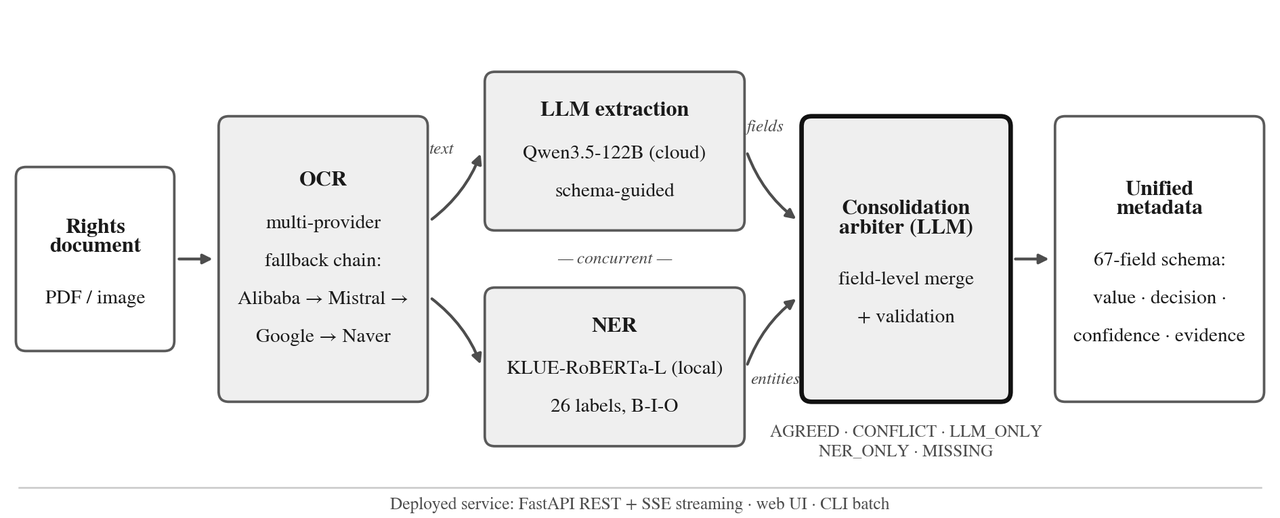
A deployed NER + LLM “division of labor” pipeline for Korean public-domain rights documents: a multi-provider OCR fallback chain feeds a fine-tuned KLUE-RoBERTa-Large NER model (26 B-I-O labels) and schema-guided LLM extraction running concurrently, and an LLM consolidation arbiter produces a unified 67-field schema with per-field provenance (AGREED / CONFLICT / LLM_ONLY / NER_ONLY / MISSING) and OCR-grounded Korean evidence.
Year 2 adds image + text multimodal analysis — generative VLMs and SigLIP 2 + FAISS similarity — over a 144k-work KOGL corpus. The work is funded by the MCST/KOCCA copyright R&D program, in a consortium with Muhayu and HM Company serving the Korea Copyright Commission (Gongu Madang) and the Korea Culture Information Service Agency (KOGL).
Voice Phishing Detection 2021 – present
South Korea’s National Police Agency counts 260,694 cumulative vishing incidents from 2016 to 2025, with KRW 6,015.3 billion (≈ USD 4.11 B) in damage. Against that backdrop the lab built KorCCVi, the first labeled Korean voice-phishing transcript dataset, and progressed from ML/DL text classifiers and KoBERT to an attention-based CNN-BiLSTM (F1 0.9966), federated learning, and multilingual back-translation with SMOTE augmentation.
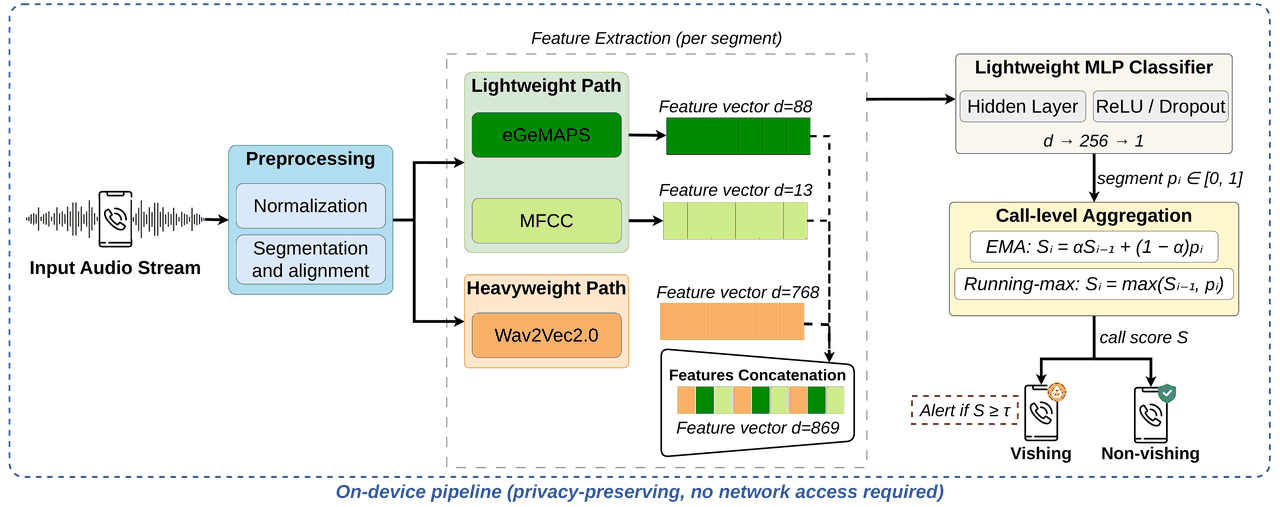
The current line is multimodal (audio + text) and privacy-preserving: lightweight acoustic models (≤223K parameters; 99.59% accuracy with eGeMAPS features) and channel-robust Wav2Vec2.0 with EMA call-level aggregation (F1 ≈ 0.956–0.96 under GSM codec-matched evaluation) — efficient enough for real-time detection; see the papers for benchmark details.
Digital Forensics 2010 – 2020
A decade of digital forensics on flash storage: recovery of deleted and wiped files on NAND flash, anti-forensics via block permutation to prevent recovery, wiping-evidence acquisition, selective recovery under the SSD TRIM command, YAFFS2 file-system metadata management, and circumstantial-evidence recovery for forensic timeline analysis.
The same line extends to databases in the field — SQLite deleted-record recovery, journaling-of-journal-based SQLite file recovery, and message recovery from instant messengers. Altogether this area produced more than ten master’s theses between 2010 and 2020.
Flash Storage & FTL 2004 – present
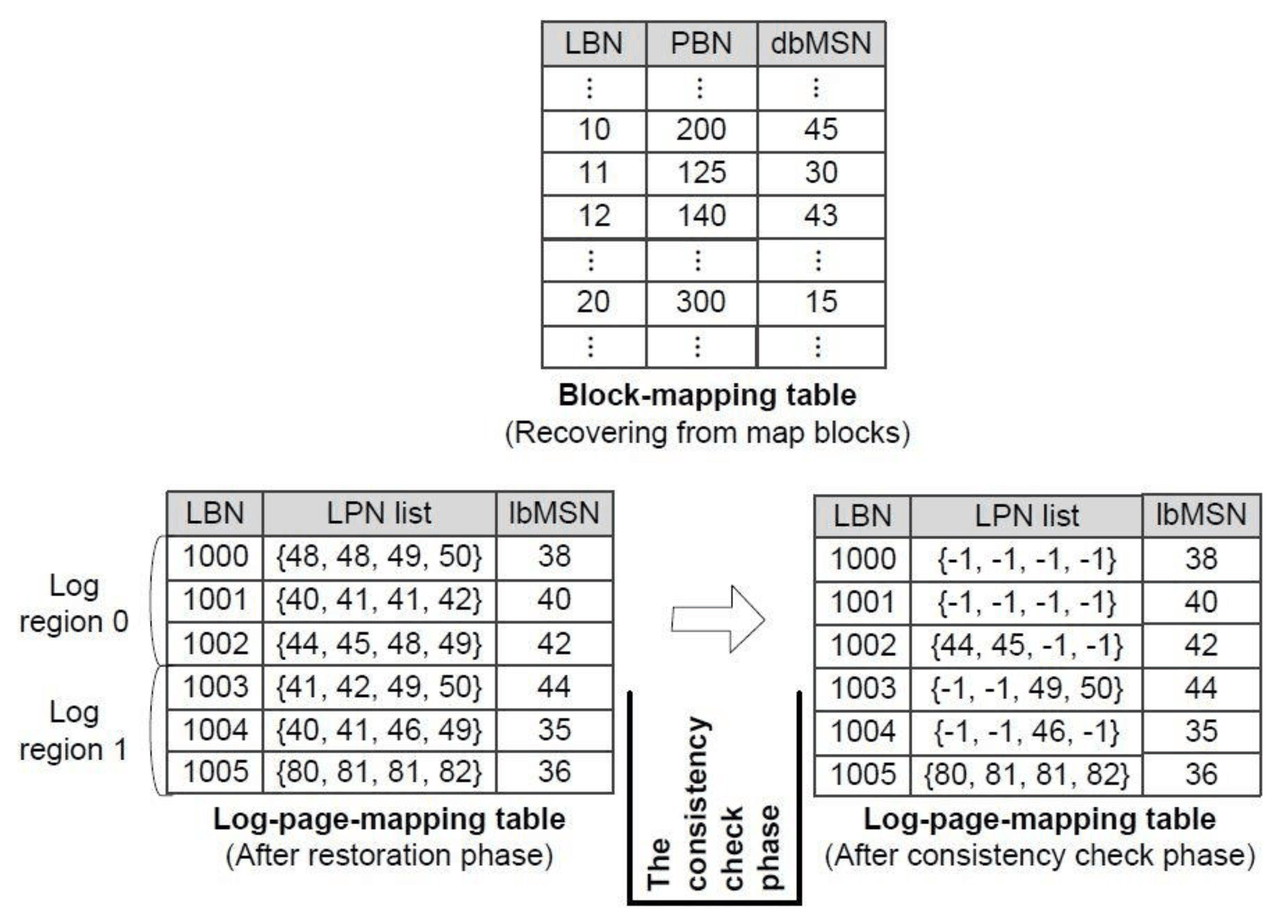
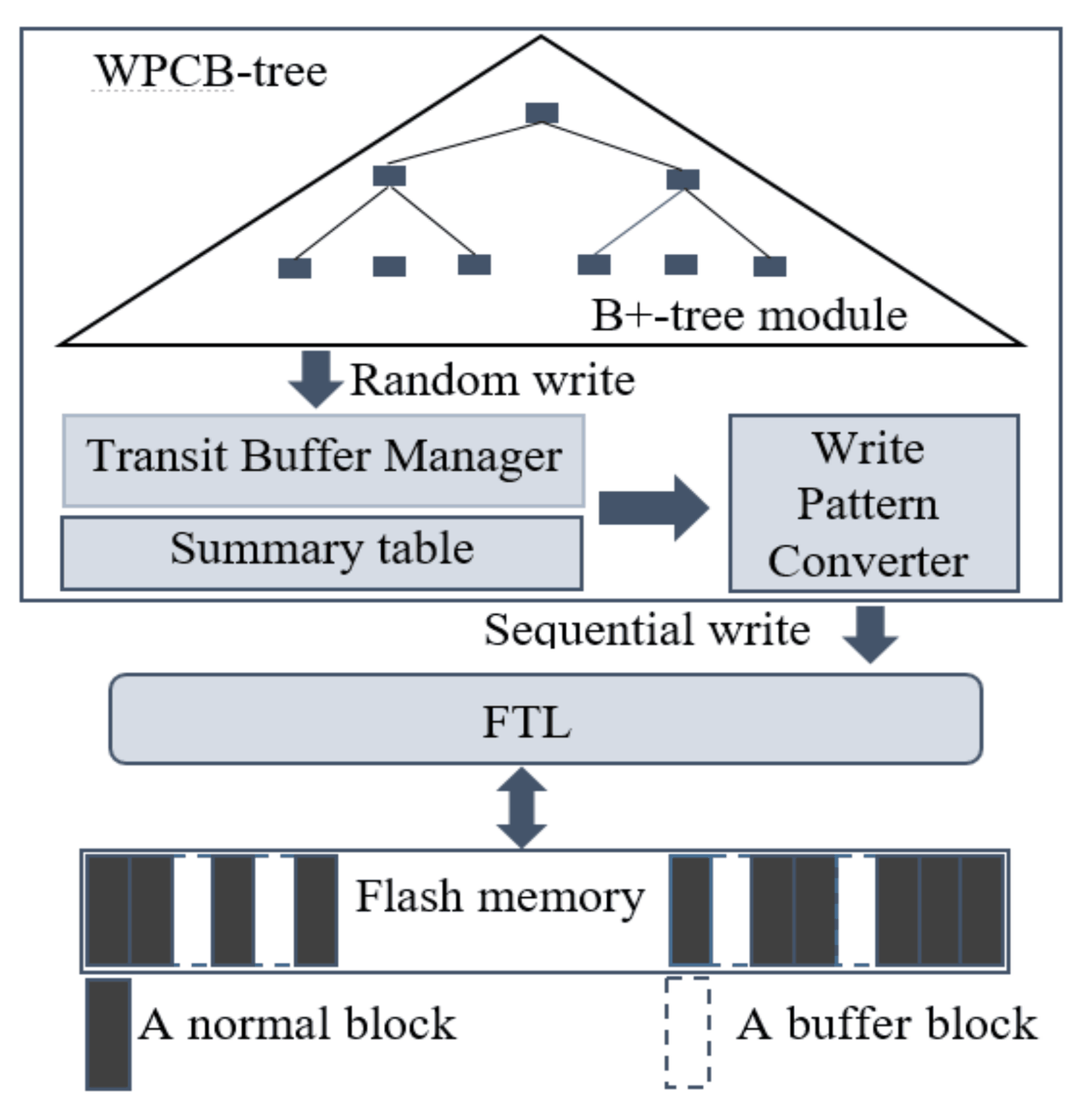
The lab co-created the widely cited FAST flash translation layer (“A log buffer-based flash translation layer using fully-associative sector translation”, ACM TECS 2007 — cited 700+ times) and the LSTAFF/LSTAFF* system software for large-block flash. The work spans FTL design and surveys, hybrid address mapping, buffer replacement, flash-aware B-tree indexing (WPCB-Tree), and crash and data recovery on NAND flash and SSDs.
Its roots run deeper still: before flash, the lab worked on database systems and spatial/multimedia indexing — k-nearest-neighbor queries with semantic predicates (Spy-Tec+, RS-tree), distance browsing, and GIS object prefetching (1999–2011). Today the flash line feeds directly into the undergraduate File Processing course, whose assignments build an emulated NAND device driver and an FTL from scratch.
Datasets & Code
-
KorCCVi — Korean Call Content Vishing
DatasetThe first labeled Korean voice-phishing transcript dataset, grown across versions from v1.3 to v3; the multimodal line adds a call-audio corpus of 1,417 calls (706 vishing / 711 non-vishing) with 39,429 utterance segments — 66.9 hours at 16 kHz mono.
v1.3 ~6,005 rows · v2.1 ~20,857 rows · v3 ~18,646 rows · audio 1,417 calls / 66.9 h
-
Augmented Vishing Dataset
DatasetKorCCVi with multilingual back-translation and SMOTE augmentations — 2,927 original samples (695 vishing / 2,232 non-vishing) plus ~3,502 augmented samples, released on IEEE DataPort in November 2024.
DOI 10.21227/163c-0542 · CC BY-NC-SA 4.0 · 216 MB
-
Korean_Voice_Phishing_Detection
CodeOpen code for the vishing paper series — ML/DL text classifiers, KoBERT, attention CNN-BiLSTM, federated learning, and multimodal audio–text fusion.
public repo · 24 stars · Python/PyTorch
Projects
-
Development of Content Analysis and Type-Information Determination Technology for the Global Diffusion of Openly Licensed (Shared) Works
ActiveMinistry of Culture, Sports and Tourism (MCST) · KOCCA · Apr 2025 – Dec 2026
-
SW-Centered University Program
ActiveMinistry of Science and ICT (MSIT) · IITP
-
MSIT/IITP research grant 2018-0-00209 (title not published)
CompletedMinistry of Science and ICT (MSIT) · IITP